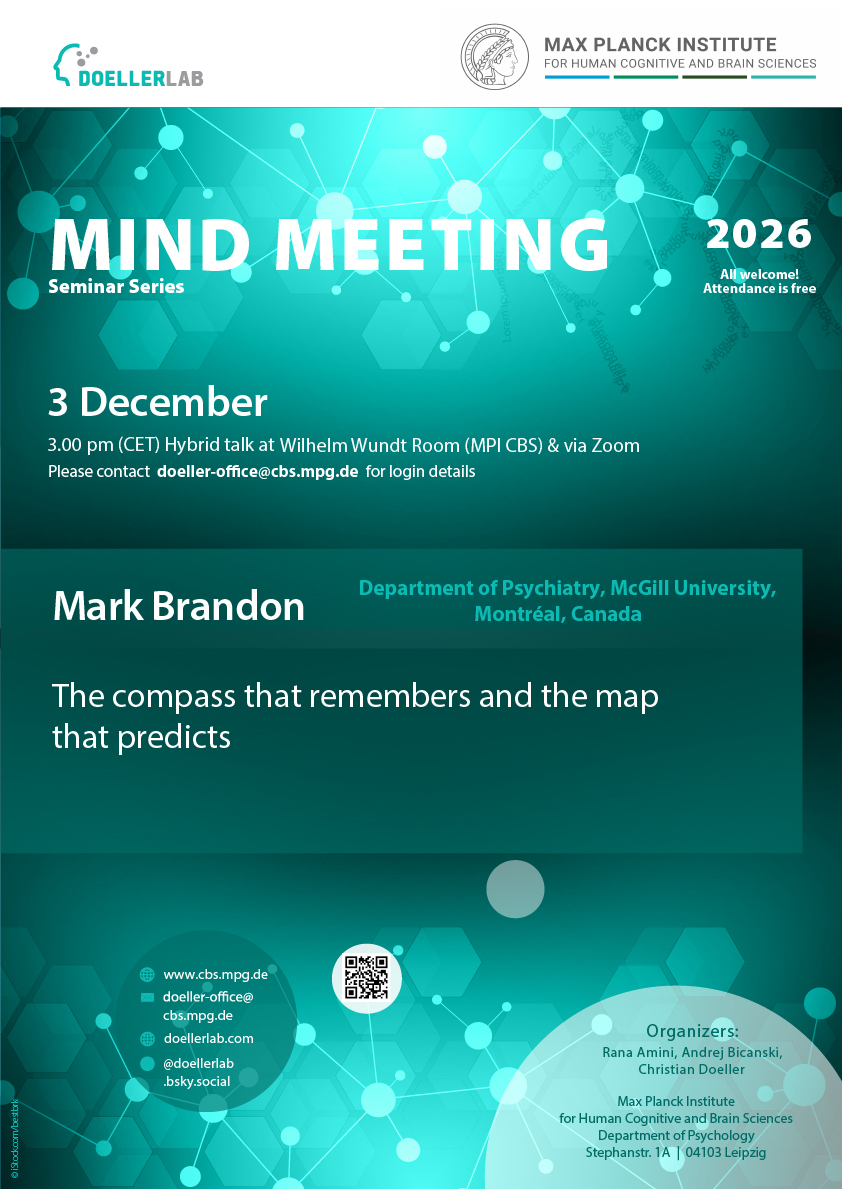


The Mind Meeting Seminar Series is back! On Tuesday 3 December 2026, 3.00 pm CET, Dr. Mark Brandon, McGill University (Canada), will give a hybrid talk entitled “The compass that remembers and the map that predicts“.
The talk, organized by the Doeller Lab and Bicanski Lab, will take place on site (in the Wilhelm Wundt Room at the MPI CBS) and virtually via Zoom. Please join us and subscribe to the Mind Meeting Mailing List on our homepage!
Abstract
Head direction cells and place cells are usually described as encoding where an animal is facing and where it is. Imaged at scale, during cue conflict and across weeks of learning, both populations turn out to carry information no tuning curve shows, one about the past and one about the future. In the anterodorsal thalamus, head direction population activity varies along a second dimension, network gain, that emerges under cue conflict and ambiguity, predicts whether and how fast the network realigns to a shifted landmark, and in darkness retains a trace of the landmark last seen. The compass anchors according to its history with a cue rather than to the cue alone (Ajabi et al., Nature 2023). In CA1, the fraction of reward-tuned cells falls over weeks of training, and a subset shift their activity backward in time until they fire for the task features that precede and predict reward. A temporal difference model in which reward prediction error pulls place fields backward reproduces the shift (Yaghoubi et al., Nature 2026). The compass updates in seconds and the map over weeks, but both move for the same reason, a mismatch between the animal’s internal estimate and what the world delivers.