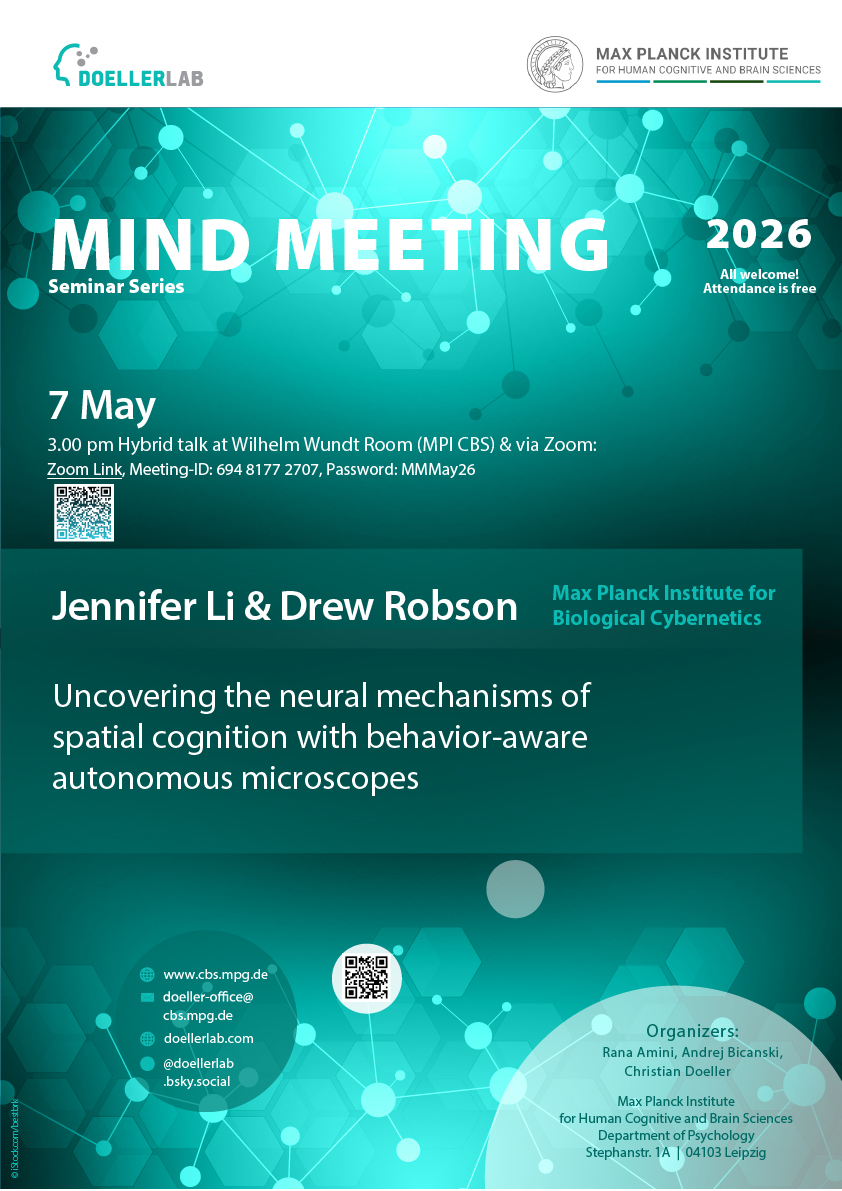


The Mind Meeting Seminar Series is back! On Thursday 7 May 2026, 3.00 pm CET, Dr. Jennifer Li and Dr. Drew Robson (Max Planck Institute for Biological Cybernetics, Tübingen) will give a hybrid talk entitled “Uncovering the neural mechanisms of spatial cognition with behavior-aware autonomous microscopes”.
The talk, organized by the Doeller Lab and Bicanski Lab, will take place on site (in the Wilhelm Wundt Room at the MPI CBS) and virtually via Zoom. Please join us and subscribe to the Mind Meeting Mailing List on our homepage!
Zoom link: https://eu02web.zoom-x.de/j/69481772707?pwd=pYbqsZ201bQvOjr8FBweQJz5MZdzJi.1
Meeting-ID: 694 8177 2707
Kenncode: MMMay26
Abstract
A core technological challenge in neuroscience remains the inability to access most of the brain, most of the time, across most of an animal’s lifespan. To overcome this limitation, my lab develops self-driving tracking microscopes that enable brain-wide, cellular-resolution calcium imaging in freely moving larval zebrafish. Using this platform, we have uncovered the neural correlates of exploitation–exploration states during foraging, revealed novel sleep substates with distinct eye-movement kinematics, and discovered place cells for the first time in a non-amniote animal. The existence of place cell in the larval zebrafish brain suggests that abstract spatial cognitive representations can be generated by a compact neural network of only 100,000 neurons, opening the door to brain-wide mechanistic analysis of the underlying circuitry.
Building on these discoveries, my lab is now focused on 1) uncovering the neural architectures that underlie spatial cognition in the vertebrate brain through joint analysis of brain-wide activity and brain-wide synaptic connectivity in the same animal, and 2) understanding the developmental processes that expand spatial representational capacity over time. I will highlight engineering efforts to create autonomous systems with embedded intelligence that enable whole-brain recording across circadian and developmental timescales without human intervention, making it possible to directly track the emergence, stabilization, and reorganization of spatial cognitive networks within a single animal over development.